Even though this youtube is not in english I still thought the photography and video footage is beautiful and inspiring ... Tasha Tudor is certainly a favorite of mine.
Friday, March 12, 2010

Wednesday, March 10, 2010
Tuesday, February 2, 2010
Angela's Shortbread Recipe

1 Cup softened butter1 Cup powdered sugar1 egg yolk1/4 teaspoon salt2 Cups FlourBeat butter, sugar, egg yolk together. Stir salt and flour together, then stir into butter mixture. Pat into glass pan. Slice patted dough into small squares and prick with fork. Bake for 25 min at 350 degrees Fahrenheit
Sunday, November 29, 2009
Pumpkin Soup in a Pumpkin Shell :)
I made this soup for Thanksgiving this year, and it turned out really tasty, as well as being super-fun to serve :)
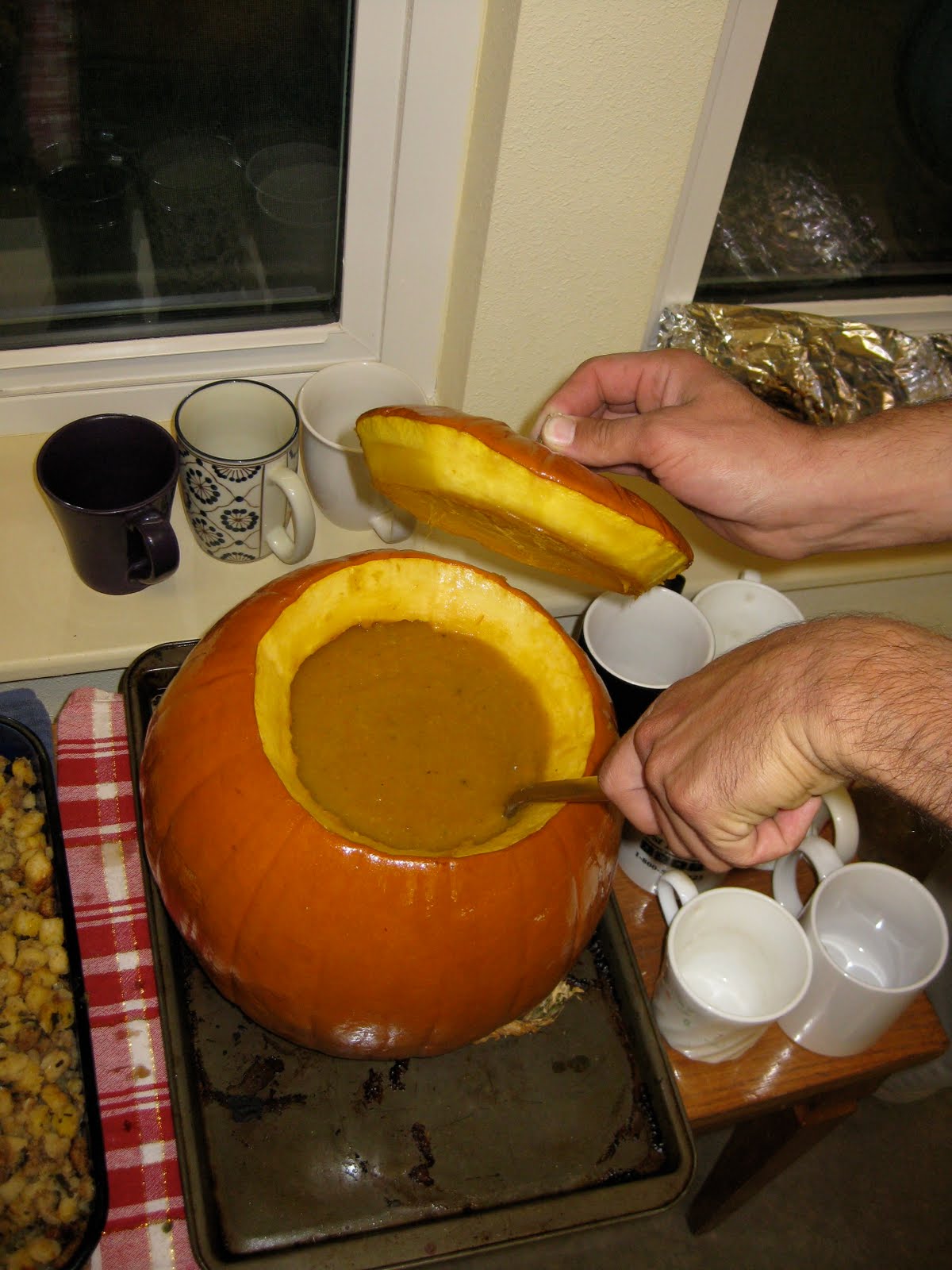
Elegant Pumpkin Soup Served in a Pumpkin Shell
1 large fresh pumpkin (about 12 inches in diameter) for serving the soup in.
2 1/2 cups fresh, cooked pumpkin or canned pumpkin
2 cups chicken broth + 1 cup milk (or 3 cups broth total for dairy-free)
4 tbsp. butter (or olive oil for dairy-free)
2 T. flour (rice flour for gluten-free)
1 large onion, chopped
2 stalks celery, diced
1 sprig of fresh thyme
1/2 tsp fresh marjoram, chopped fine
4 cloves garlic, minced or crushed
1/2 tsp. curry powder
1/4 tsp. ginger
1/4 tsp. nutmeg
1/8 tsp. chili powder
salt and pepper to taste
(a touch of honey or stevia to taste if it seems too bitter at the end)
Cut the top (one third) of your pumpkin to create a lid for your pumpkin serving bowl. Scoop out the seeds and strings, cleaning the inside well of any debris. Clean the seeds and place them on a cookie sheet. Sprinkle the seeds with a little salt. Roast in a 250°F oven until lightly golden brown. Set them aside to be used as a garnish. Heat the pumpkin shell and lid in a 250ºF oven while making the soup.
In a large soup pot, melt 2 T. of butter over a medium heat. Sauté the
Meanwhile, in a separate sauce pan, melt the remaining 2 T. of butter over medium heat. Whisk in 2 T. flour and cook for several minutes, whisking constantly, until it starts to smell savory. Whisk in the milk (or the remaining cup of broth) a little at a time. Blend well. Cook for several minutes, until it starts to bubble and thicken, whisking periodically to keep it from sticking to the bottom. Remove from heat.
Remove thyme sprig from pumpkin mixture. Remove the mixture from the
Whisk the flour, butter, and milk/broth mixture into the pumpkin puree. Simmer for 5 minutes more. Pour soup into your hollowed-out pumpkin serving bowl. Serve the toasted pumpkin seeds on the side for garnish and plenty of fresh cracker pepper.
Enjoy! :)
Wednesday, November 18, 2009
the braided scarf

This is a really beautiful scarf that I thought you all would enjoy ... especially since there are video tutorials included.
From the spud and chloe blog :
Scarf knitting season is finally here! Maybe for some of you, like me, it never left. I am thrilled to be bringing Braided to you as a free pattern today. This is a fast and fun scarf that you can whip up on big needles in no time at all. It’s the perfect gift scarf for the holiday seasons ahead. The easy care/machine washable Outer yarn makes it even more appealing.
Here is some information you may want to know at a glance:
3 skeins of Spud & Chloë Outer (I used Soapstone #7200)
US size 17 needles or size to obtain gauge
US size 13 double-pointed needles, set of 4
Gauge: 1.75 sts per inch in stockinette stitch
The scarf involves ribbing (knit and purl stitches) and I-cord and braiding. If you can do those techniques you are all set to go!
Click here to download the pattern for Braided!
Look here for a series of video tutorials on how to knit Braided!
Enjoy.
Please note: When beginning a Rib Section after a Braided Section the yarn will be set to start a Row 2 or wrong side of the rib pattern.
I have embedded the first video here:
Thursday, October 15, 2009
hunting large game (survival tools)
My new favorite video! This was really cool to me. It is the ultra compound bow. This is certainly a weapon I want to know how to use for hunting.
Wednesday, October 7, 2009
Roasted Pepper Medley
 This is a regular recipe I use often and I like to keep it on hand to spice-up on all sorts of things -- I like it best on salads. It really adds a lot of flavor! Enjoy!
Ingredients:
-2 Red bell peppers
-2 Yellow bell Peppers
-1/4 Cup of Olive Oil
-2 tsp salt
-1 Lemon (juiced)
-2 cloves of garlic minced
Wash peppers and bake in Oven at 350 degrees until they are puffed up and lightly browned (about 15 min). Remove and (without burning your fingers!) peel away the skin - it should peel away without too much difficulty. If it does not come off easily then it probably should be baked longer. After removing the skin, dice the peppers and place in a container (that preferably has a lid - otherwise the fridge will smell like peppers and garlic!) Add into the container the remaining ingredients and mix. Cover and place in the fridge. Let set and marinate for several hours. Keeps well for several days.
Wednesday, September 23, 2009
Essene Bread

Adapted from Wild Fermentation, by Sandor Ellix Katz
Sprout 3 cups whole grains:
1. Place whole grains in a wide-mouth gallon jar with a piece of mesh or
cheesecloth stretched over the mouth, secured with a rubber band.
2. Fill jar with water and soak grains for about 12-24 hours at room temperature.
3. Drain and discard the water.
4. Set the jar upside down in a measuring cup or small bowl. Ensure that the jar
rests safely above wherever the water drains. If the grains sit in water, they
will rot rather than germinate.
5. Rinse the sprouts with fresh water at least twice a day, morning and evening,
more often if possible. In hot weather especially, rinse often. The aim is to
keep the sprouts from drying out or molding.
6. You’ll know the grains have germinated when you see little tails emerging
from them. Use them within 2-3 days of germination for maximum sweetness.
Be sure to keep rinsing the sprouts at least twice a day.
Grind the sprouted grains with a blender or food processor. Leave some sprouted grains
whole, if you wish.
Add ¼ cups sourdough starter and ½ teaspoon sea salt.
Stir thoroughly. (note : I left out these two ingredients with mine)
Optional: add sunflower seeds, herbs, raisins, grated carrot.
Lightly oil a loaf pan and pour the mixture into the pan.
Cover with a clean cloth and leave to ferment in the pan at room temperature for a day or
two.
Dry the loaf in the oven at 200-degrees for about 4 hours. You can tell it’s ready when
the bread shrinks away from the sides of the pan.
If you are like me you might enjoy seeing someone else make this bread on a video : Sprouted Manna Bread (essene bread)
Tuesday, September 22, 2009
Edible Plants
I am super excited because here is a series of youtube videos on identifying wild edibles! I think this is so important for survival and even just to become familiar with your area. There are many books on this subject but I learned much more from watching these videos and it was fun!
Monday, May 19, 2008
Goat Yogurt Recipe
To Make Goat Milk Yogurt at Home
Start with fresh, unpasteurized, goat milk that has been produced in a sanitary manner. Heat milk to 108 degrees Fahrenheit. As a starter culture (good bacteria), you can either use our Redwood Hill Farm plain yogurt or a freeze-dried culture purchased from a health or natural food store. In addition, use yogurt from a new cup and use a clean spoon to add it to the milk. Use l Tablespoon per quart of milk or if using a freeze-dried culture, follow package directions.
After the culture has been added, you must incubate the milk at 104-108 degrees. To do this, you can use a home yogurt maker or devise something on your own. Some people use a heating pad wrapped around a jar, put it in the oven on low, or a jar in a crock-pot. What ever you use, experiment with water and a thermometer before you actually make the yogurt to be sure you can hold the milk at the required temperature. Incubate for 6-8 hours depending on your taste. When done incubating, chill the yogurt before eating being careful not to agitate or move the yogurt much until it is well chilled.
Goat milk will not get as thick as cow milk yogurt. In addition many cow yogurts add powdered milk to thicken the yogurt. We use a small amount of tapioca (natural from the cassava root) in our Redwood Hill Farm yogurt. You can use whatever suits you to thicken the yogurt or enjoy a yogurt drink.
Start with fresh, unpasteurized, goat milk that has been produced in a sanitary manner. Heat milk to 108 degrees Fahrenheit. As a starter culture (good bacteria), you can either use our Redwood Hill Farm plain yogurt or a freeze-dried culture purchased from a health or natural food store. In addition, use yogurt from a new cup and use a clean spoon to add it to the milk. Use l Tablespoon per quart of milk or if using a freeze-dried culture, follow package directions.
After the culture has been added, you must incubate the milk at 104-108 degrees. To do this, you can use a home yogurt maker or devise something on your own. Some people use a heating pad wrapped around a jar, put it in the oven on low, or a jar in a crock-pot. What ever you use, experiment with water and a thermometer before you actually make the yogurt to be sure you can hold the milk at the required temperature. Incubate for 6-8 hours depending on your taste. When done incubating, chill the yogurt before eating being careful not to agitate or move the yogurt much until it is well chilled.
Goat milk will not get as thick as cow milk yogurt. In addition many cow yogurts add powdered milk to thicken the yogurt. We use a small amount of tapioca (natural from the cassava root) in our Redwood Hill Farm yogurt. You can use whatever suits you to thicken the yogurt or enjoy a yogurt drink.
Sunday, April 27, 2008
Thursday, March 27, 2008
Natural tick repellent
My 12 year old shih-tzu just had a really bad reaction to a Frontline treatment my mom gave her a couple of days ago. She's been in pain, pacing, whining, yelping if anyone touches her, and panting. I google searched her symptoms, and on the first page of results was a page all about adverse reactions people's dogs had had to tick treatments. I found quite a few people who listed the exact same symptoms my dog had for Frontline - except they got a lot worse, including seizures, tumors, and sometimes death. So I immediately washed the Frontline off my dog, and she already feels better.
But there are still ticks out there, and I'd like her to have *some* blood left in her body by the end of summer. So what's a country girl to do?
Green Living says Rose Geranium oil is the best natural tick repellent there is. Dilute it in a carrier oil - 2 tbs nut or vegetable oil per 10-25 drops essential oil - and put 2 drops on the dog's collar.
The site where I found the info about Frontline also has a post (about 2/3 of the way down, if you're interested) that says that apple cider vinegar in their water (1 tsp/gallon) makes them taste bad to ticks.
My aunt once told me about garlic pills, and a couple of sites confirmed it, but who wants to get their face licked by a dog with garlic breath? I think I'm just going to stick with the Rose Geranium oil.
But there are still ticks out there, and I'd like her to have *some* blood left in her body by the end of summer. So what's a country girl to do?
Green Living says Rose Geranium oil is the best natural tick repellent there is. Dilute it in a carrier oil - 2 tbs nut or vegetable oil per 10-25 drops essential oil - and put 2 drops on the dog's collar.
The site where I found the info about Frontline also has a post (about 2/3 of the way down, if you're interested) that says that apple cider vinegar in their water (1 tsp/gallon) makes them taste bad to ticks.
My aunt once told me about garlic pills, and a couple of sites confirmed it, but who wants to get their face licked by a dog with garlic breath? I think I'm just going to stick with the Rose Geranium oil.
Tuesday, March 25, 2008
Religious cows?
This doesn't have much to do with country girl know-how, but it's about cows and Catholics so it counts, right?
http://holywhapping.blogspot.com/2008_03_01_archive.html#3295265637808101056
You have two cows...
Franciscan: You have two cows. Moved by the beauty of sister cow, you unleash them. Your ensuing lack of milk allows you to glory in the poverty of Christ.
Carmelite: By concession of Pope Innocent IV, you have two cows. You don’t eat them between Sept. 14 and Easter.
Discalced Carmelite: You have two cows. You feed them by arduously dragging hay to their tough, but then you deliver it by truck. Ultimately, abundant hay falls effortlessly from the sky.
Benedictine: You have two cows. You use one to preserve the art of animal husbandry for all time. You kill the other and make intricate, colored markings on its hide.
Dominican: You have two cows. You feel as if you should share one with the Franciscans, but can’t bring yourself to trust them with it.
Cistercian: You have a more extraordinary method of procuring milk.
Carthusian: You should have two cows, but they never made it to the Grand Chartreuse since they kept mixing up the difference between "Cistercian" and "Carthusian."
Trappist: You have two cows. You do not appreciate their mooing, yet require their milk to craft high quality fudge. You assign them to a novice.
Jesuit: Your institutions own thousands of animals in the bovine tradition, but you are rightly concerned that the poor have none.
Opus Dei: You have two donkeys, and tend to them very carefully. You never admit that you engage in this work, but are delighted to meet other covert donkey owners.
Communion and Liberation: You have two cows, and bring them to huge annual gatherings. You speak to them only in the present tense.
SSPX: You have two cows. You raise them precisely according to USDA standards, c. 1950. One cow denies that the USDA exists and runs off to take care of itself.
St. Egidio: You gather two cows together in a very old barn and reflect on Scripture. Other cows begin to come, too. You sell their milk for third world debt relief.
Augustinian: Posthumously, two cows claim you as their owner. One of them burns down the northern half of the barnyard.
Salesian: You have no cows, but work to improve the welfare of calves orphaned by factory farming. You inspire them to love Christ, and occasionally dream about their futures.
http://holywhapping.blogspot.com/2008_03_01_archive.html#3295265637808101056
You have two cows...
Franciscan: You have two cows. Moved by the beauty of sister cow, you unleash them. Your ensuing lack of milk allows you to glory in the poverty of Christ.
Carmelite: By concession of Pope Innocent IV, you have two cows. You don’t eat them between Sept. 14 and Easter.
Discalced Carmelite: You have two cows. You feed them by arduously dragging hay to their tough, but then you deliver it by truck. Ultimately, abundant hay falls effortlessly from the sky.
Benedictine: You have two cows. You use one to preserve the art of animal husbandry for all time. You kill the other and make intricate, colored markings on its hide.
Dominican: You have two cows. You feel as if you should share one with the Franciscans, but can’t bring yourself to trust them with it.
Cistercian: You have a more extraordinary method of procuring milk.
Carthusian: You should have two cows, but they never made it to the Grand Chartreuse since they kept mixing up the difference between "Cistercian" and "Carthusian."
Trappist: You have two cows. You do not appreciate their mooing, yet require their milk to craft high quality fudge. You assign them to a novice.
Jesuit: Your institutions own thousands of animals in the bovine tradition, but you are rightly concerned that the poor have none.
Opus Dei: You have two donkeys, and tend to them very carefully. You never admit that you engage in this work, but are delighted to meet other covert donkey owners.
Communion and Liberation: You have two cows, and bring them to huge annual gatherings. You speak to them only in the present tense.
SSPX: You have two cows. You raise them precisely according to USDA standards, c. 1950. One cow denies that the USDA exists and runs off to take care of itself.
St. Egidio: You gather two cows together in a very old barn and reflect on Scripture. Other cows begin to come, too. You sell their milk for third world debt relief.
Augustinian: Posthumously, two cows claim you as their owner. One of them burns down the northern half of the barnyard.
Salesian: You have no cows, but work to improve the welfare of calves orphaned by factory farming. You inspire them to love Christ, and occasionally dream about their futures.
Saturday, March 8, 2008
Notes from 'Mineralizing your soil, your food and -- you!' by Joe Esposito
Gemma and I attended a 4 hour seminar in Peggs on the subject of remineralizing your soil. Very informative and a very relevent subject. Here are some of my notes:
Joe had a BRIX reader at the seminar. Using liquid from any plant, the device gives a reading of the minerals and sugars in the plant. On a normal BRIX reader 4 is poor and 10 is good. Typical grocery store veggies are '0.5' and a well mineralized garden vegetable can be up in the '30' range. I think of this reading as 'how much alive' is the plant *really low brix means a 'dead food' in my mind*
Read more on BRIX: http://en.wikipedia.org/wiki/Brix *Do a google search also if you want - lots there*
A mix of books from the seminar and randome notes:
Garlic - Heinrich P. Koeh *Garlic used to be used commonly as an antibiotic*When growing your own garlic be sure the soil has lots of nutrients and hummus since garlic is a natural source of lots of minerals.
Folk Medicine - D.C. Jarvis MD (A New England almanac of natural health care from a noted Vermont country doctor
Overcoming Parasites Naturally - Dr. James R. Overman ND
Alkalize or Die - Dr. Theodore A Baroody
Choose life or Death - Carey A Reams with Cliff Dudley *Reams and Einstein were friends*
Nutrition and Physical Degeneration - Weston A Price
*Most maple syrup harvesters use formaldicide to keep the sap holes open longer ...yuck!
*Liver has high amounts of vitamin A
The Makers Diet - Jordin S. Rubin
Flood your body with oxygen - Ed McCabe
*Mentions using food grade hyrodgen peroxide to oxygenate water*Hydrogen Peroxide Treatment is used in Europe. See : http://en.wikipedia.org/wiki/Hydrogen_Peroxide#Therapeutic_use
Supposedly, according to Joe Esposito it did not rain before the great flood (the plants were 'watered' by a mist that came up through the ground *unkown to me*) and that there were no seasons (the earth must have had a completely veritcal axis). Any thoughts?
Essential fatty acids are important in bringing oxygen into the body's cells. The cultures who's people have a history of longevity had diets composed of highly mineralized soil and plant food with little carbohydrate food.
Dented Corn *looks dehydrated to me* is a sign of calcium deficiency. When making cornbread and such; popcorn and indian corn are healthier and of a higher quality with more minerals.
Insects can't eat plants high in sugar (highly mineralized plants are much sweeter) because they don't have livers and will leave these healthy plants alone. So you won't need all the insecticides.
The body does not store potassium and so it must be consumed every day (500 mg/day). Foods high in potassium - bananas, celery, molasses, sardines, etc. *you will never lose weight in there is a potassium deficiency*
Microbes are the 'digestion' for soil. Plants won't absorb the minerals without them.
Daily water consumption: 1/2 the body weight in oz.
Maintain a healthy body PH. http://www.alkalizeforhealth.net/salivaphtest.htm
Joe had a BRIX reader at the seminar. Using liquid from any plant, the device gives a reading of the minerals and sugars in the plant. On a normal BRIX reader 4 is poor and 10 is good. Typical grocery store veggies are '0.5' and a well mineralized garden vegetable can be up in the '30' range. I think of this reading as 'how much alive' is the plant *really low brix means a 'dead food' in my mind*
Read more on BRIX: http://en.wikipedia.org/wiki/Brix *Do a google search also if you want - lots there*
A mix of books from the seminar and randome notes:
Garlic - Heinrich P. Koeh *Garlic used to be used commonly as an antibiotic*When growing your own garlic be sure the soil has lots of nutrients and hummus since garlic is a natural source of lots of minerals.
Folk Medicine - D.C. Jarvis MD (A New England almanac of natural health care from a noted Vermont country doctor
Overcoming Parasites Naturally - Dr. James R. Overman ND
Alkalize or Die - Dr. Theodore A Baroody
Choose life or Death - Carey A Reams with Cliff Dudley *Reams and Einstein were friends*
Nutrition and Physical Degeneration - Weston A Price
*Most maple syrup harvesters use formaldicide to keep the sap holes open longer ...yuck!
*Liver has high amounts of vitamin A
The Makers Diet - Jordin S. Rubin
Flood your body with oxygen - Ed McCabe
*Mentions using food grade hyrodgen peroxide to oxygenate water*Hydrogen Peroxide Treatment is used in Europe. See : http://en.wikipedia.org/wiki/Hydrogen_Peroxide#Therapeutic_use
Supposedly, according to Joe Esposito it did not rain before the great flood (the plants were 'watered' by a mist that came up through the ground *unkown to me*) and that there were no seasons (the earth must have had a completely veritcal axis). Any thoughts?
Essential fatty acids are important in bringing oxygen into the body's cells. The cultures who's people have a history of longevity had diets composed of highly mineralized soil and plant food with little carbohydrate food.
Dented Corn *looks dehydrated to me* is a sign of calcium deficiency. When making cornbread and such; popcorn and indian corn are healthier and of a higher quality with more minerals.
Insects can't eat plants high in sugar (highly mineralized plants are much sweeter) because they don't have livers and will leave these healthy plants alone. So you won't need all the insecticides.
The body does not store potassium and so it must be consumed every day (500 mg/day). Foods high in potassium - bananas, celery, molasses, sardines, etc. *you will never lose weight in there is a potassium deficiency*
Microbes are the 'digestion' for soil. Plants won't absorb the minerals without them.
Daily water consumption: 1/2 the body weight in oz.
Maintain a healthy body PH. http://www.alkalizeforhealth.net/salivaphtest.htm
Friday, March 7, 2008
A few of my favorite things...
Just a couple of links I use sometimes
www.hennaforhair.com
www.mountainroseherbs.com
Thursday, March 6, 2008
Welcome!
I just wanted to say welcome to the newest blog member - MaryCatherine! I should have started the tradition ealier of welcoming each member as they came on board ... well better late than never (lol)
Thursday, February 21, 2008
Throw out the chemicals and use more economic and safe solution
Saving Money & Wasting Less Lesson 4: Around the house
I really enjoyed this article since it brings together simply the many uses of everday household products for cleaning, etc.
Introduction to the article:
In this lesson we will look at how to save money on the common products used in the home. The products suggested are not just cheap, they are natural and not toxic chemicals and so will help save the environment as well as money.
How toxic is your house anyway?
We are encouraged constantly by advertising to make our houses toxic by spraying chemicals around them. We use surface sprays that last for months to kill insects we're often not even sure we have, we 'bomb' our houses to get the chemicals into every nook and cranny in the house. They also get into every nook and cranny of our lungs, and on our skin.
We use chemical cleaners, deodorants, air fresheners and carpet cleaners, and we reach for chemicals in the form of pills every time we have the slightest ache or pain. Is the toxicity of our environment the reason so many people suffer these days from allergies.
We will also look at how clutter in your home can cost you money, and look at how to save money and time on housework.
Some of the household products used in the article:
Sodium bicarbonate (baking soda, bicarb, bicarb soda)
Washing soda (sodium carbonate)
Vinegar
Cloudy ammonia
Lemons
Borax
Salt
Beer
I really enjoyed this article since it brings together simply the many uses of everday household products for cleaning, etc.
Introduction to the article:
In this lesson we will look at how to save money on the common products used in the home. The products suggested are not just cheap, they are natural and not toxic chemicals and so will help save the environment as well as money.
How toxic is your house anyway?
We are encouraged constantly by advertising to make our houses toxic by spraying chemicals around them. We use surface sprays that last for months to kill insects we're often not even sure we have, we 'bomb' our houses to get the chemicals into every nook and cranny in the house. They also get into every nook and cranny of our lungs, and on our skin.
We use chemical cleaners, deodorants, air fresheners and carpet cleaners, and we reach for chemicals in the form of pills every time we have the slightest ache or pain. Is the toxicity of our environment the reason so many people suffer these days from allergies.
We will also look at how clutter in your home can cost you money, and look at how to save money and time on housework.
Some of the household products used in the article:
Sodium bicarbonate (baking soda, bicarb, bicarb soda)
Washing soda (sodium carbonate)
Vinegar
Cloudy ammonia
Lemons
Borax
Salt
Beer
Monday, November 5, 2007
Chicken Breast Sauce Recipe
1/4 cup butter
1/4 cup flour
1 tablespoon lemon juice
2 cups chicken broth or stock
1/2 cups light cream
(if you do not have cream, milk will work, but the sauce will be thinner)
Melt butter in saucepan and blend in flour. Add chicken broth. Cook, stirring constantly until thickened. Add lemon juice. Stir in cream. Heat, but do not allow it to boil. Makes approximately 3 cups. Serve over spaghetti noodles, chicken, and spinach. I usually double this recipe, since everyone loves the leftovers.
1/4 cup flour
1 tablespoon lemon juice
2 cups chicken broth or stock
1/2 cups light cream
(if you do not have cream, milk will work, but the sauce will be thinner)
Melt butter in saucepan and blend in flour. Add chicken broth. Cook, stirring constantly until thickened. Add lemon juice. Stir in cream. Heat, but do not allow it to boil. Makes approximately 3 cups. Serve over spaghetti noodles, chicken, and spinach. I usually double this recipe, since everyone loves the leftovers.
Sunday, October 7, 2007
Costume Pattern Link
I found this link on www.colleenhammond.com. It has a bunch of patterns from the Victorian and Edwardian periods.
http://www.tudorlinks.com/treasury/freepatterns/index.html
http://www.tudorlinks.com/treasury/freepatterns/index.html
Wednesday, September 26, 2007
HOW TO MAKE BUTTER FROM GOAT MILK
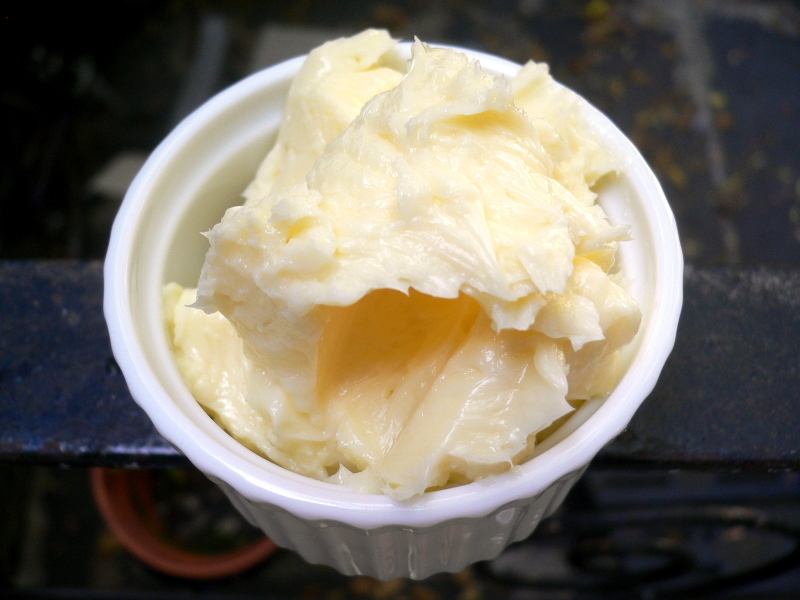 From Mother Earth News
Butter made from goat milk is every bit as good as the same spread made from cow's milk. "As good as", please note. . . not "just like".
For one thing, goat butter has a lower melting point other cow butter . . . possibly because the milk from which it comes contains a higher proportion of unsaturated fatty acids. It's also pure white (unless a butter color is added before churning). The reason is that Nanny—a more efficient machine than a cow—has already converted all the carotene in her product to vitamin A.
Another difference: It's a little more difficult to obtain cream from goat milk because the buttermilk globules are very small . . . partially homogenized, you might say. Thus the rich layer rises more slowly than the larger fat particles in cow milk. In fact, the process may take several days (and you'll have a storage problem to cope with meanwhile).
This problem, of course, can be solved with a create separator right after milking, while the liquid is still warm. The catch is that it's not easy to find such a device these days except as a lucky find, secondhand, in some out-of-the-way place. (Unfortunately, the De Laval Separator Company—one of the last firms to make small hand-operated and electric models in North America—has discontinued the line and I know of no other source for new cream separators except one yet-unproven company recently located in India by Countryside magazine.—MOTHER.)
Apart from cream, here's what you need to make goat butter: a dairy thermometer or other instrument with a range of 50° to 150° F, a small glass churn . . . either hand or electric, butter color if desired, and a double boiler (or a pan of convenient size set into a larger pot of water).
Prepare for buttermaking by letting your cream stand at room temperature overnight—or about 12 hours—so that the butterfat globules will ripen. Add a few drops of coloring at this point if you want the finished product to be yellow.
Next, heat the cream in the double boiler to 146°, give or take a degree or two. Use a thermometer . . . don't guess, is soon as you obtain the correct reading, set the top pan in cold water and cool the contents to 52°-60° F in summer (58°-66° in winter).
The liquid can then be poured into the churn (fill it only half full) and agitation started. If your temperature is correct, butter should "come" in 30 to 40 minutes. Cream that's too cold will take longer to make up and will give you a hard spread which is difficult to work. If the fluid's too warm, rite churning will be incomplete and will yield a soft, greasy from which you won't be able to wash the buttermilk.
Your work is finished when the butterfat has gathered up in granules the size of a pea. (You'll also notice a change in the sound of the dasher.) Pour off the buttermilk through the holes in the top of the churn (they also allow gases to escape), Be sure to save the liquid!
Next, fill the churn with water of the same temperature as the new-made butter. (Too much warmth will melt the fat, and a cold bath will harden it and make it difficult to knead.) Give the handle a few gentle turns and pour off the washing fluid. Repeat this operation two or three times until the rinse water runs clear.
Finally, spread the butter in a shallow pan or wooden bowl and add salt if you like . . . 3/4 ounce to the pound, or as much as tastes good to you. Work the mass by pressing it with a spoon or plastic spatula. Fold the butter over and press again. Continue in this manner until no more water seeps out under pressure. You're then ready to form your spread into any desired shape. I mold mine in covered pint-sized plastic containers that are available at reasonabie prices from any supermarket or dime store.
Remember that your homemade goat butter contains no preservatives and must be kept in the refrigerator when you aren't using it. If left out at room temperature it will melt or become rancid.
Nevertheless, don't hesitate to make lots of this delicious natural food when you have a surplus of milk. I've kept butter frozen for six months or more, and when I thawed and used the spread it was just like fresh-made. I suggest packing and freezing your churn's output in plastic tubs and transferring it, still frozen, to pint Kordite freezer bags. The resulting square packages are easy to stack in the coldstorage unit.
If the buttermaking method I've outlined sounds like too much work or, involves too much equipment, there are alternatives . . . usually less satisfactory, it's true, but experimentation is part of the fun of "doing it yourself". For example, butter can be made in a mixer, or a pint of cream can be shaken in a quart fruit jar until the fat solidifies. My recommendations about churning temperature also hold true for these procedures. Incidentally, it is possible to churn whole milk . . . but you must use a large amount of raw material for a very small return.
That's about it. Experiment, have fun, and enjoy your own delicious, nutritious, natural goat butter.
TIPS ON HANDLING MILK
[1] Milk itself, and all the utensils you use in its storage and processing, must be absolutely clean. Remember that this "perfect food" is ideal nourishment for bacteria too.
[2] Never cover warm goat milk when you put it in the refrigerator, because the resulting condensation can affect the taste. Place a lid on the container only after its contents are cold. It follows that you must cover all strong-smelling fruits and vegetables—onions, canteloupes, etc.—that are being stored at the same time, or the milk may pick up the odors and develop an "off" flavor.
[3] Skimmed goat milk is very tasty and contains all the original nutrients except most of the butterfat. If you eat the butter and drink the buttermilk that's left after churning, you'll be getting all the goodness your milch doe has to offer. (If you don't like buttermilk, incidentally, your chickens will.)
All articles in this Archive are reprinted just as they were originally published; the publication date is shown in the URL address at the top of the page. Source listings, addresses and prices have not been updated; some details may have changed and terminology may be outmoded.In some cases the scanning software used to create the digital articles has introduced typos into the text. In particular, the software often translated fractions incorrectly, i.e. "1/2" now reads as "112". We are working to correct these errors.
Subscribe to:
Posts (Atom)
